Visual First
Build workflows by connecting nodes visually. No code required to get started, but fully extensible when you need it.
Flow-Like is a visual workflow platform for connecting data, services, and user interfaces through typed workflows. Build and inspect the same logic as a visual graph or as FlowScript.
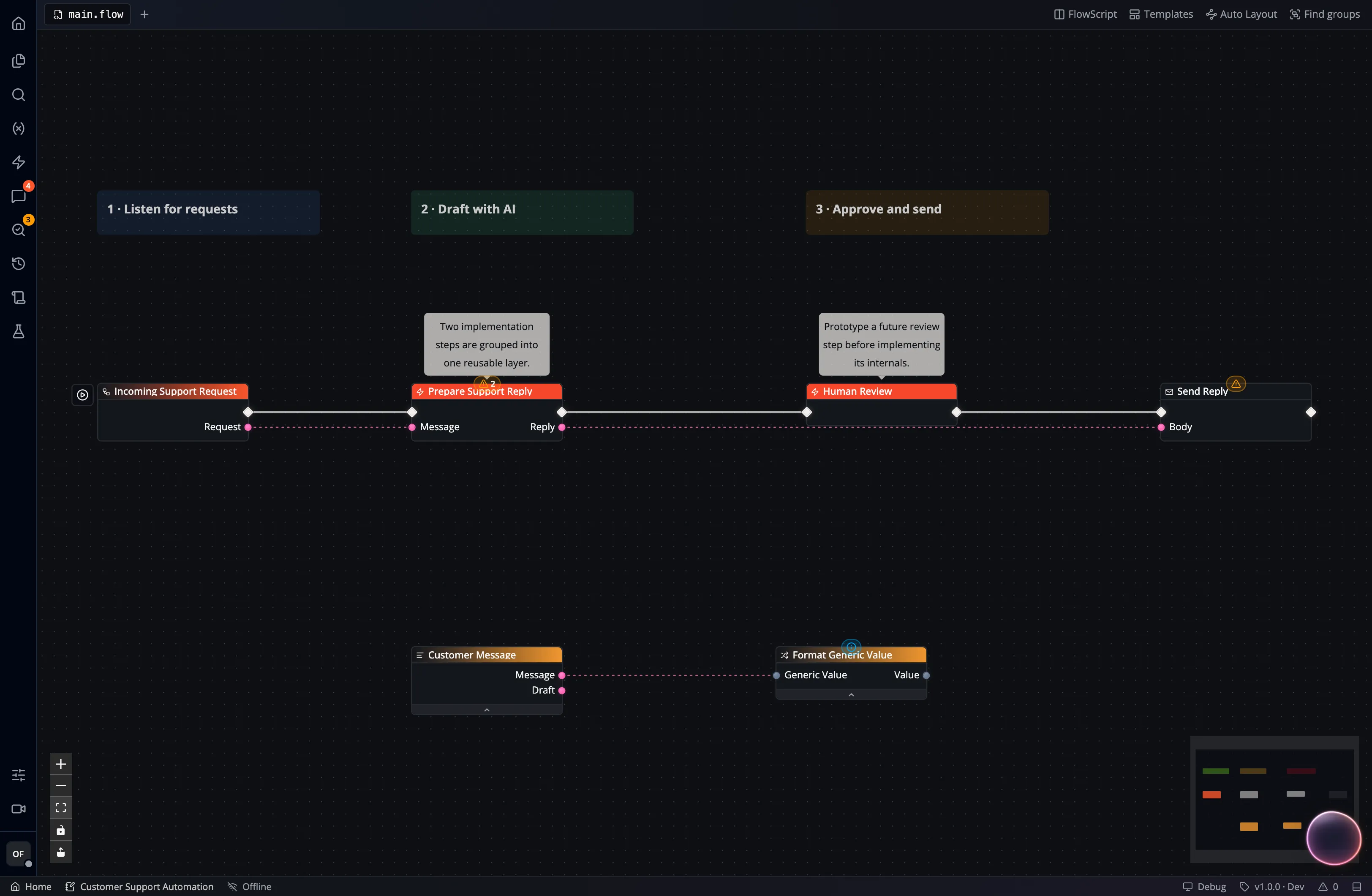
A support-workflow prototype in Studio, organized into request, draft, and review stages.
Visual First
Build workflows by connecting nodes visually. No code required to get started, but fully extensible when you need it.
Type-Safe
Typed pins let the editor reject incompatible connections before a run. Runtime validation and representative tests still matter for actual data.
Rust Performance
The runtime is built in Rust for predictable execution, native performance, and extensibility.
Run Anywhere
Build locally, run on the desktop, or connect the same Flow model to a hosted or self-managed deployment.
A Flow is a directed graph of nodes. Execution connections control which steps run, and data connections supply values. Run logs record the available evidence according to the Flow’s logging configuration.
Nodes are the building blocks. Their pins can carry input data, output data, or execution control. Pure nodes have data pins and run when another node needs their output; event nodes start execution. See Nodes.
Every pin has a type. Flow-Like checks compatibility when you connect pins. This catches wiring mistakes; it does not guarantee that an API will respond or that an input value meets every business rule.
Flow-Like Desktop is designed to work offline. Start on your laptop, then connect to a hosted or self-managed environment when collaboration and remote execution are useful.