
Flow-Like Architecture
Flow-Like is a monorepo with Next.js/React clients and a modular Rust workspace. The clients share one UI package and a set of backend-state interfaces; adapters connect those interfaces to local browser/Tauri state or remote services.
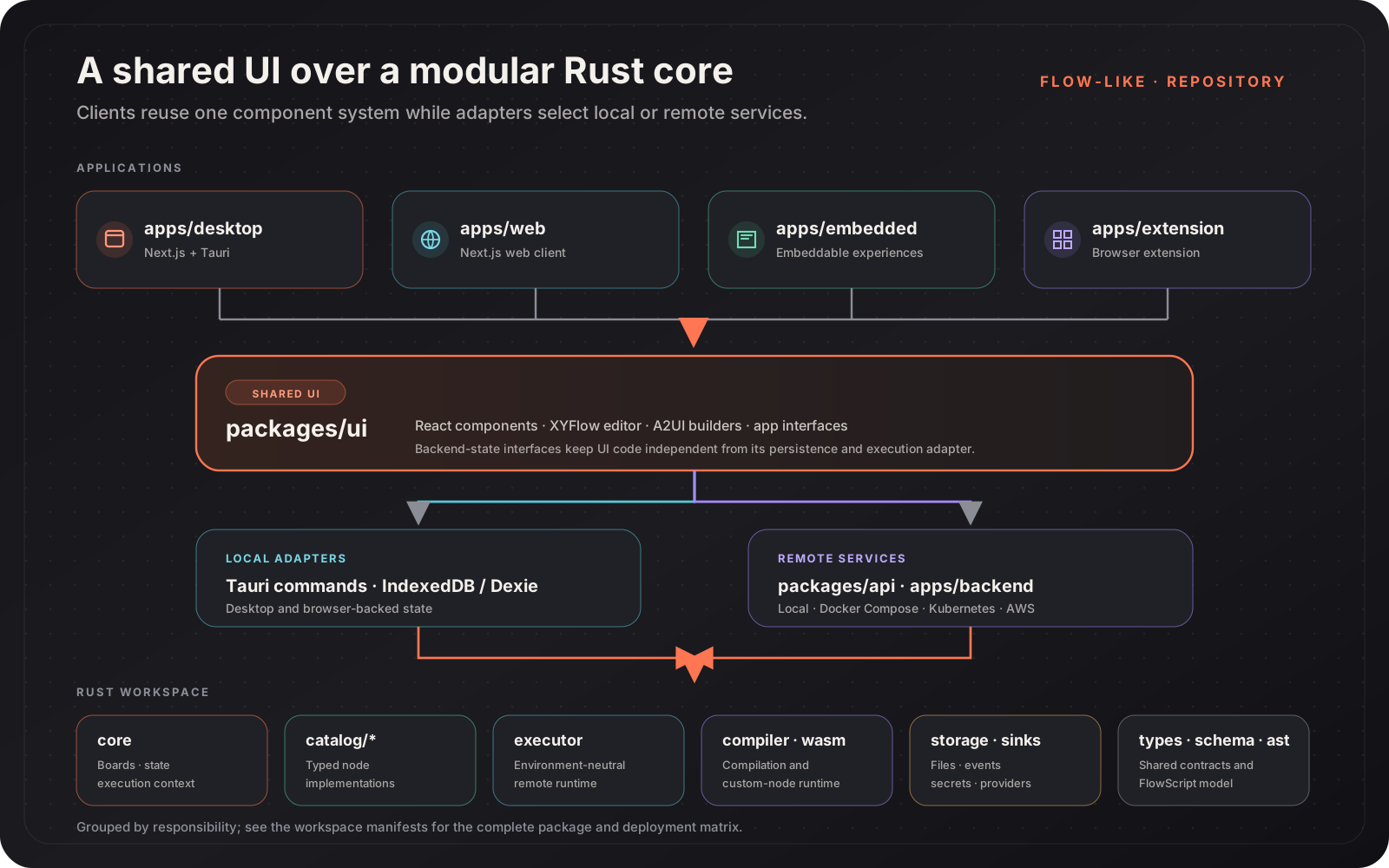
Repository Layers
Section titled “Repository Layers”Applications
Section titled “Applications”| Directory | Responsibility |
|---|---|
apps/desktop | Next.js client hosted by Tauri for local and desktop-capable operation |
apps/web | Next.js web client |
apps/embedded | Embeddable app experiences |
apps/extension | Browser extension |
apps/backend/local | Local API and runtime binaries |
apps/backend/docker-compose | Single-stack services, proxy, runtime, compiler, signaling, and monitoring |
apps/backend/kubernetes | API, executor, compiler, sink trigger, Helm chart, and deployment utilities |
apps/backend/aws | AWS API, executor, compiler, event bridge, and supporting functions |
apps/backend/signaling | Shared signaling service |
apps/docs / apps/website | Documentation and public website |
apps/schema-gen / apps/utils | Schema and repository utilities |
The root Cargo workspace contains the Rust applications and packages. The root Bun workspace contains apps/*, packages/*, and libs/*/*.
Shared Frontend
Section titled “Shared Frontend”packages/ui contains the reusable React layer:
- the XYFlow-based visual workflow editor;
- A2UI renderer, Page/Widget builder, and app interfaces;
- settings and library components;
- backend-state contracts and their browser-backed implementations;
- query, assistant, execution-service, and global state integrations.
The state interfaces are the important boundary. A component can request Pages, routes, Events, boards, storage, or executions without hard-coding whether the data comes from IndexedDB, a Tauri command, or an API-backed adapter.
Core Packages and Contracts
Section titled “Core Packages and Contracts”| Package group | Responsibility |
|---|---|
packages/core | Boards, nodes, pins, variables, app state, execution context, and Flow-Like domain logic |
packages/catalog and packages/catalog/* | Node registration and implementations split by domain |
packages/types / packages/schema | Shared contracts and schemas |
packages/ast | FlowScript text-domain model, parsing, rendering, linting, and signatures |
packages/storage | Local, memory, cloud, and generic object-store abstraction |
packages/secrets | Secret-management integrations |
packages/sinks | Event sinks and triggers |
packages/api | Remote API, authentication/authorization boundaries, execution dispatch, and service state |
packages/executor | Environment-neutral remote execution runtime with callback and streaming modes |
packages/compiler / packages/wasm | WASM compilation and custom-node runtime |
packages/model-provider | Model-provider and local inference integrations |
packages/catalog-macros / packages/catalog-build-helper | Catalog registration and build support |
packages/dexie-tauri-adapter | Desktop adapter for browser/Dexie-backed data |
The catalog currently includes domain crates for automation, core, data, geo, LLM, media, ML, ONNX, processing, standard nodes, and web operations.
Client-to-Runtime Boundary
Section titled “Client-to-Runtime Boundary”The same frontend package can operate in different environments:
| Environment | Typical path |
|---|---|
| Desktop/local | React component → backend-state interface → IndexedDB/Dexie or Tauri command → local Rust state/runtime |
| Remote/web | React component → backend-state interface → API client → flow-like-api → storage, dispatch, or remote executor |
| Embedded | Shared use interface with app, route, and Event context supplied by its host |
This split is why a feature should normally be added to the interface first, then implemented by each adapter that supports it.
Workflow Execution
Section titled “Workflow Execution”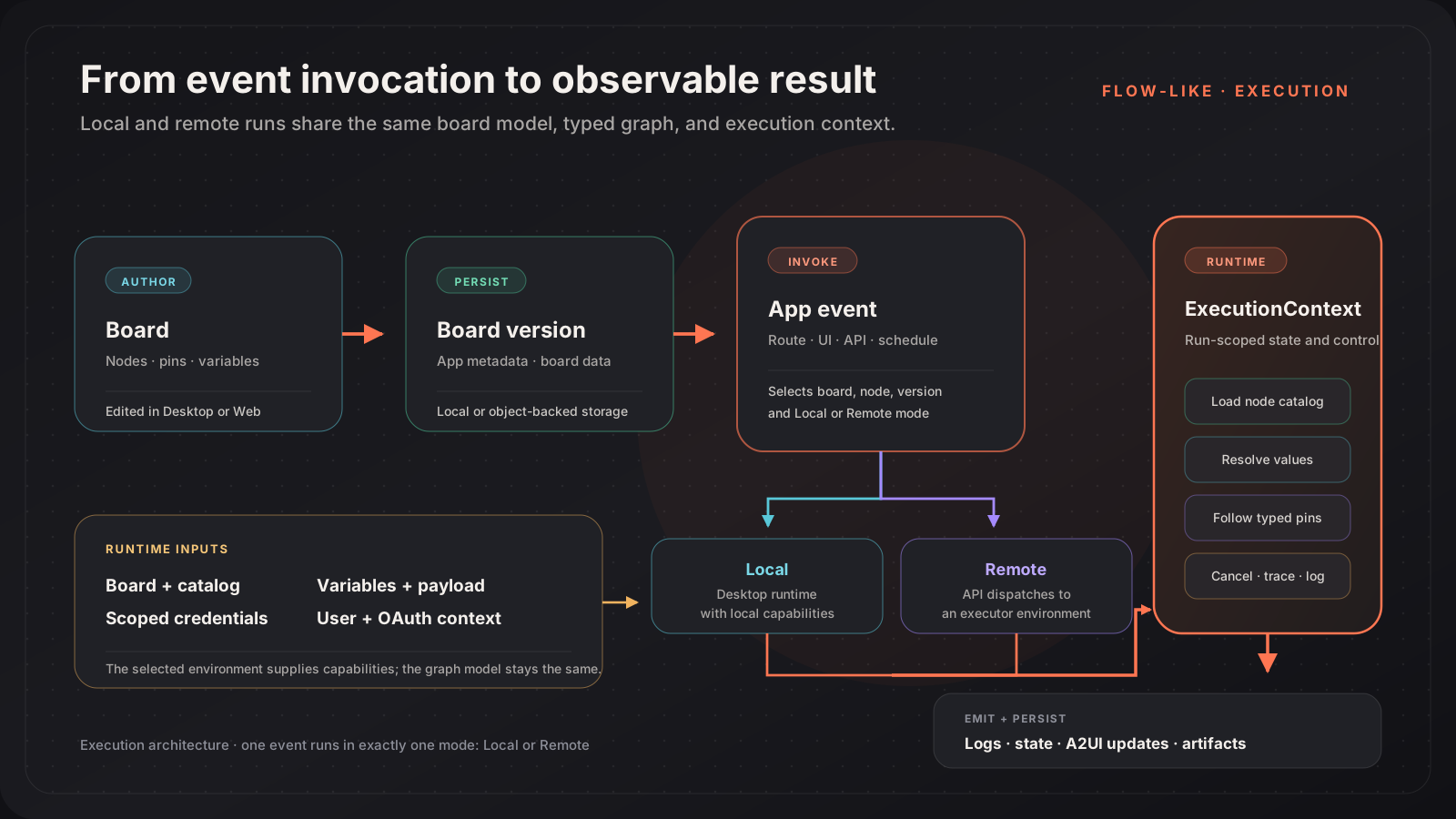
- An author edits a Board made of nodes, pins, variables, and connections.
- Flow-Like persists the Board and its app metadata. Versioned runs can select a specific Board version.
- An app Event identifies the Board and entry node. Each Event runs in exactly one execution mode:
LocalorRemote. - The selected environment loads the Board, node catalog, payload, variables, user/OAuth context, and scoped credentials.
ExecutionContextevaluates data pins and follows execution pins through the connected graph.- The run emits logs, progress, state, A2UI messages, and results; artifacts and run data are persisted through the configured stores.
The packages/executor crate provides the remote runtime independently of a specific deployment target. It supports streaming responses and callback delivery, while deployment applications provide the surrounding HTTP, queue, container, or function environment.
Type and Graph Model
Section titled “Type and Graph Model”Every pin has:
- a direction (
InputorOutput); - a data type, including
Execution, scalar values, structures, and generic values; - a value shape such as a normal value, array, or set;
- optional schema and default-value information.
Execution pins control graph traversal. Non-execution pins carry values and are evaluated through the execution context. Struct values can carry schema information, and FlowPilot/FlowScript validation uses the same typed model to reject invalid connections before runtime.
The visual graph uses @xyflow/react; Flow-Like adds its typed node, pin, catalog, validation, layout, and execution behavior on top.
Storage Planes
Section titled “Storage Planes”Flow-Like does not assume one physical storage provider. Its storage and credential layers expose logical stores for different workloads:
| Store | Typical contents |
|---|---|
| Metadata | App and Board records, configuration, and small frequently read objects |
| Content | Uploads, generated files, media, model artifacts, and larger objects |
| Logs | Run logs and execution records |
The concrete FlowLikeStore supports local, in-memory, AWS/S3-compatible, Azure, Google Cloud Storage, and generic object-store implementations. Remote runtime credentials can scope metadata, content, and log access separately, including mixed-provider deployments.
Deployment-specific configuration may add a CDN store or database services around these core planes. Follow the relevant self-hosting guide instead of copying provider variables from another deployment target.
Event and UI Architecture
Section titled “Event and UI Architecture”Events are the bridge between external invocation and a Board:
- an Event selects a Board, node, version, and Local/Remote mode;
- UI-capable Event types provide Chat, form, or other built-in interfaces;
- a Page-target Event uses
default_page_id; - a route maps only
path → eventId; - a running Event can stream A2UI messages to the active surface.
See A2UI in Flow-Like and Routes for those frontend contracts.
Deployment Shapes
Section titled “Deployment Shapes”The repository currently contains four backend shapes:
| Shape | Repository location | Intended role |
|---|---|---|
| Local | apps/backend/local | Local API/runtime development and desktop-adjacent execution |
| Docker Compose | apps/backend/docker-compose | Self-hosted service stack |
| Kubernetes | apps/backend/kubernetes | Cluster API, compiler, executor, and sink services |
| AWS | apps/backend/aws | AWS-native API, execution, compilation, and event services |
Deployment capabilities are not inferred from package feature names alone. Check each application’s manifest and configuration because a provider or runtime may be enabled differently by each target.
Where to Make a Change
Section titled “Where to Make a Change”| Change | Start here |
|---|---|
| Shared UI or app experience | packages/ui |
| Desktop-only capability | apps/desktop and its Tauri crate |
| Web-client host behavior | apps/web |
| Domain model or local execution | packages/core |
| Node implementation | the matching packages/catalog/* crate |
| Remote request/authorization path | packages/api |
| Remote execution transport | packages/executor and the deployment app |
| Storage provider behavior | packages/storage plus deployment credentials/config |
| Custom-node compilation/runtime | packages/compiler and packages/wasm |
Continue
Section titled “Continue”- Building from Source — run the workspace locally
- Writing Nodes — extend the catalog
- Self-Hosting — select a deployment shape