
White-Labeling
Flow-Like’s white-label and OEM program is for teams that want to ship Flow-Like capabilities as part of their own product and brand. The deployment architecture, commercial rights, support, and delivered components are defined in the commercial agreement for your use case.
Choose how customers interact
Section titled “Choose how customers interact”Three common architectures separate the product surface from the execution layer:
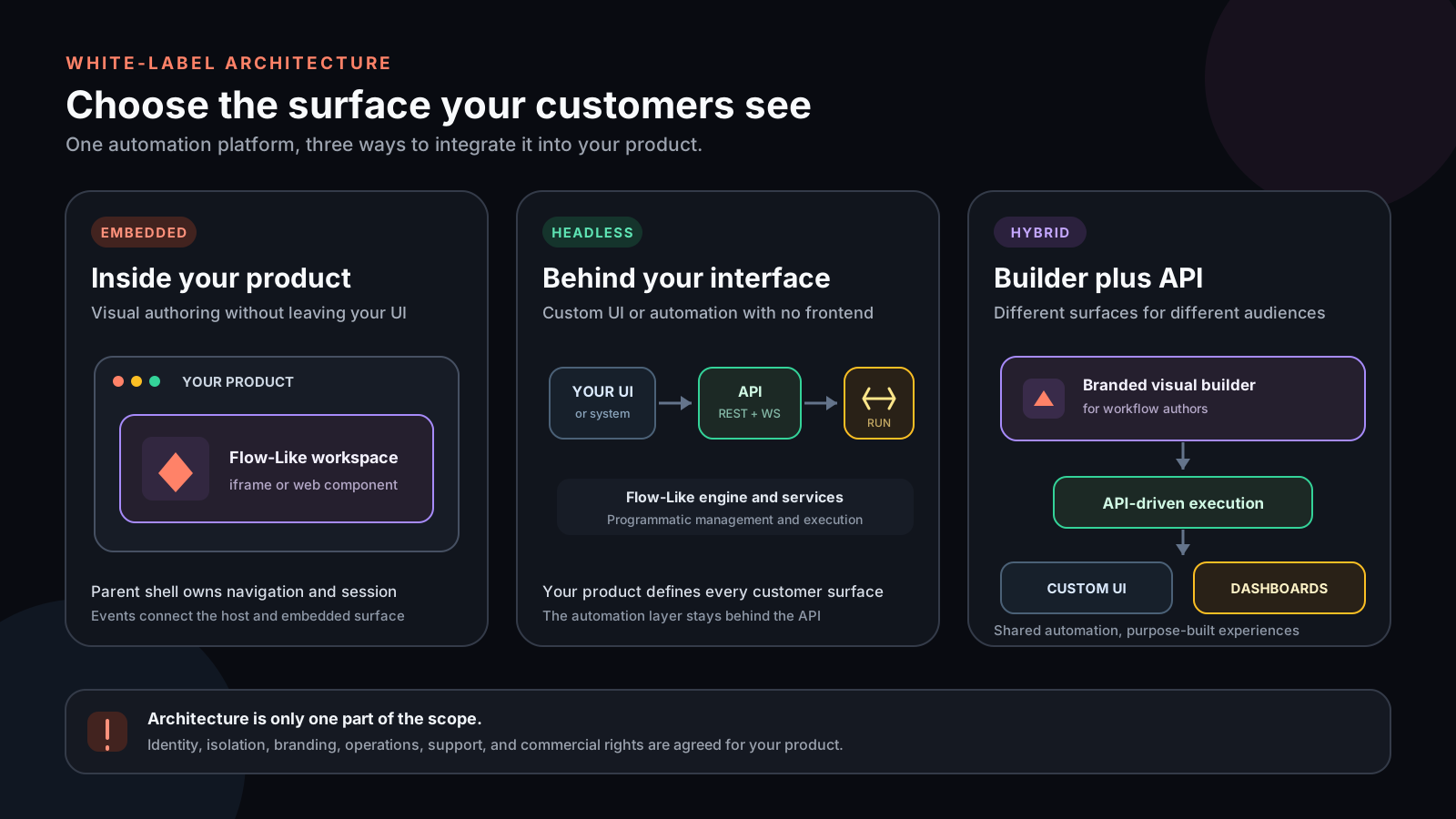
Embedded
Section titled “Embedded”Place the Flow-Like authoring experience inside your existing product through an iframe or web component. The surrounding product owns navigation and can pass sessions and events between the parent and embedded surface.
Use this when customers should design Flows without leaving your application.
Headless
Section titled “Headless”Use the Flow-Like engine and APIs behind an interface you build. A headless deployment can invoke and manage automation without exposing the Flow-Like frontend to customers.
Use this when your product needs a purpose-built UI or no customer-facing authoring UI at all.
Hybrid
Section titled “Hybrid”Combine a branded Flow-Like visual editor for builders with API-driven execution, custom dashboards, or focused end-user experiences.
Use this when different audiences need different surfaces over the same automation platform.
Scope the product surface
Section titled “Scope the product surface”White-label work commonly covers:
- visual tokens, typography, logos, favicons, and launch assets;
- custom domains and branded customer communications;
- identity integration and session passthrough;
- tenant isolation, deployment topology, and data residency;
- usage metering and integration with your billing or entitlement layer;
- API or SDK access and custom product integrations;
- support, maintenance, and upgrade responsibilities.
Availability and implementation differ by deployment. Treat this as a discovery checklist, not as a list of entitlements included in every agreement.
Prepare an implementation brief
Section titled “Prepare an implementation brief”Before requesting a proposal, document:
- Audience — who builds Flows and who only invokes them.
- Surface — Embedded, Headless, Hybrid, or a mix by customer.
- Tenancy — single tenant, multi-tenant, or dedicated deployments.
- Identity — SSO provider, user provisioning, and session handoff.
- Execution — local, hosted, customer-managed, or air-gapped.
- Branding — product name, domains, assets, theme, and communications.
- Operations — expected usage, regions, observability, SLA, and upgrades.
- Distribution — internal use, customer deployment, hosted service, or resale.
These choices determine both the technical plan and the commercial license.
Implementation paths
Section titled “Implementation paths”Teams may implement an agreed scope themselves or include professional services for branding, integrations, deployment, training, and support.
For the open customization surfaces, see Customizing & White-Label. For infrastructure planning, start with Self-Hosting and validate the exact services required by the architecture you select.
Commercial planning
Section titled “Commercial planning”Pricing and terms depend on the deployment mode, number and shape of deployments, usage, support level, and custom engineering. Do not assume a per-seat model, unlimited deployment rights, or sublicensing rights unless they appear in the proposal.
For a white-label product inquiry, contact [email protected].
For an OEM partnership, contact [email protected].
Related
Section titled “Related”- Customizing & White-Label — Technical customization guide
- Licensing — License terms and conditions
- Self-Hosting — Deployment options
- Architecture — Technical architecture overview